Optimizing Web Links Used in Digital Vaccination Invitations to Raise Trust and Booking Intention: 3 Online Randomized Controlled Trials
Abstract
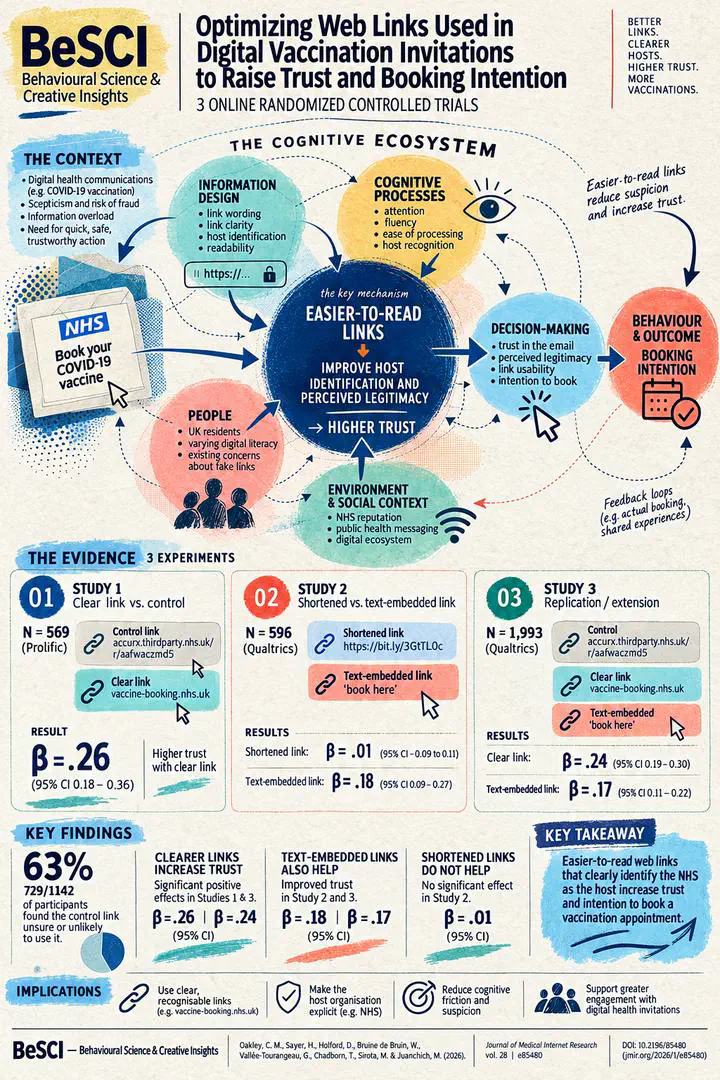
Background: People are encouraged to respond swiftly to digital health invitations, but they can be (rightly) skeptical about their legitimacy. Objective: Drawing on digital communication theory and psychological science, we hypothesized that easy-to-read web links that facilitate participants’ ability to identify the health organization as the website host would improve trust in and user engagement with digital communications. Methods: In 3 double-blind, randomized online experiments, adult UK residents were recruited via the online platform Prolific (experiment 1: N=569) or Qualtrics (experiment 2: N=596; experiment 3: N=1993). In each experiment, participants read a hypothetical email invitation for a COVID-19 vaccine from the UK’s National Health Service (NHS). Participants reported trust in the email (primary outcome), whether the web link was easy to read, who they thought the website host was, and their intention to book an appointment via the web link. Results: Clear web links with an identifiable NHS host increased trust in the invitation email and booking intention relative to the original NHS link. The text-embedded web link also improved trust, but the shortened web link did not. The clear and text-embedded web link effects were robust when controlling for demographics. Conclusions: We extend digital communication research by investigating how web link design can reduce people’s justified suspicion in health messaging.
Published open access in the Journal of Medical Internet Research. Funded by a British Academy COVID-19 Recovery grant (CRUSA210009).

Gaëlle Vallée-Tourangeau
Professor of Behavioural Science
My research explores creative cognition, sustainable decision-making, and behavioural change in creative, organisational and health contexts.